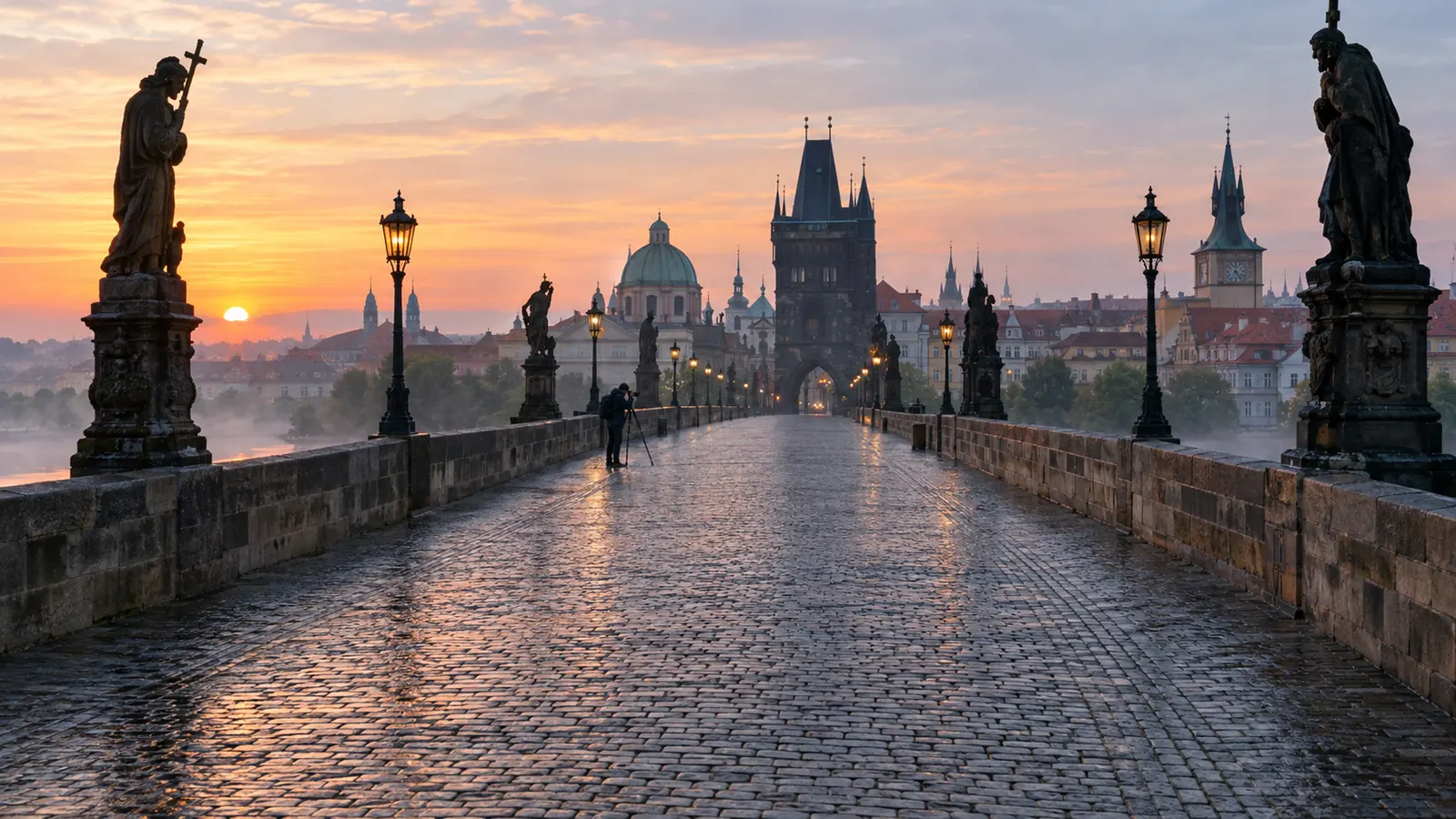
Booking choice: The guided walk and river cruise, from $50 per person. Check dates Tour details
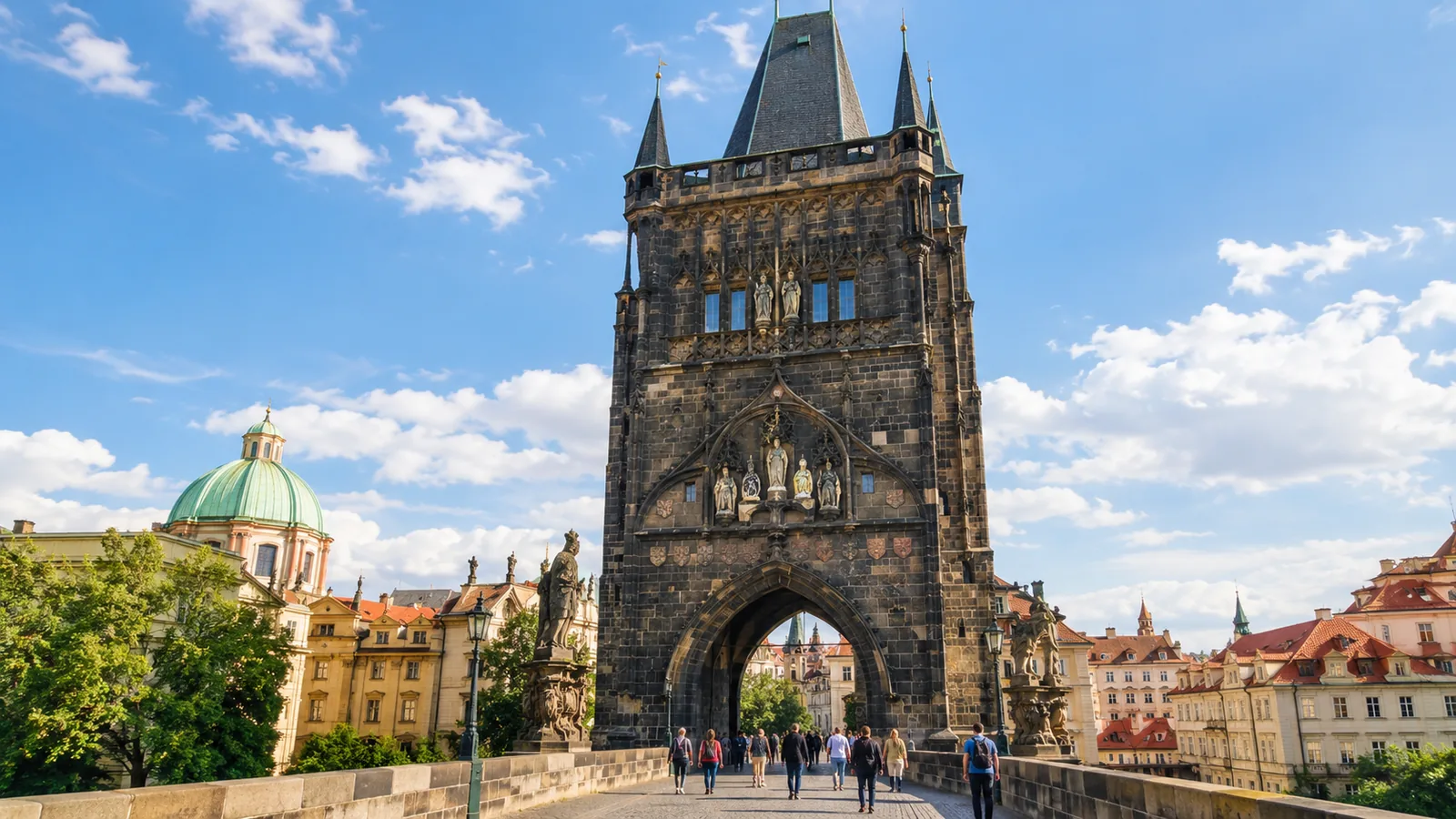
For three centuries after it was built, the bridge had almost no sculpture apart from a cross. Then, in 1683, a bronze St John of Nepomuk went up, and within thirty years donors had filled almost every pier: Jesuit colleges, the university faculties, monasteries and noble families, each paying for its patron saint. The result is an open-air gallery of Czech Baroque sculpture, with works by Matthias Bernard Braun and the Brokoff family.
The list below follows the Czech Wikipedia article on the statues of Charles Bridge and the city's own statue guide on prague.eu (in Czech), checked on 10 October 2026. Where they disagree, we say so.
The quick answer
There are 30 statues and groups. St John of Nepomuk, halfway across on the right as you walk from the Old Town, is the one people touch for luck: rub the bronze reliefs on its base, or put your fingers on the five stars of the brass cross on the parapet nearby. Many statues are copies, with originals kept indoors, but several originals remain on the bridge, Nepomuk included.
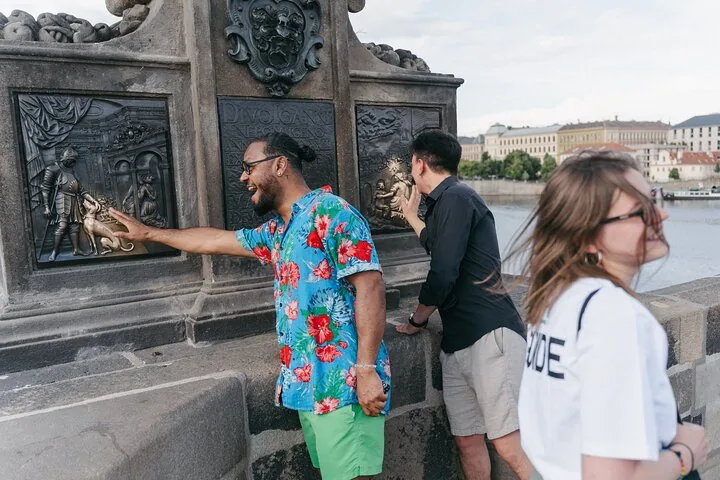
Which statue on Charles Bridge do you touch for luck?
St John of Nepomuk, on the north side halfway across. Touch the bronze reliefs on its base, or the brass cross with five stars set in the parapet.
John of Nepomuk was vicar-general of the Archbishop of Prague. In 1393 he was tortured and thrown from the bridge into the Vltava on the orders of King Wenceslas IV. The legend that grew later says he refused to reveal the queen's confession, and five stars appeared over the water where he drowned. He was canonised in 1729, and his statue on the bridge became the model for the thousands of Nepomuk statues on bridges across Central Europe.
The statue is the only bronze figure on the bridge. Jan Brokoff carved the wooden model in 1682, after a clay sketch by Matthias Rauchmüller, and it was cast in 1683. It stands about 2.5 metres high, with five stars around the head. On the base are two bronze reliefs: on the left the queen at confession, on the right the saint being thrown from the bridge. People rub them for luck, which is why the bronze shines; the reliefs you touch today are copies.
The second ritual is a few steps away. A brass double cross with five stars is set into the parapet at the spot where, by tradition, he was thrown over. Put a finger on each star and make a wish, says the legend reported by the city's guide. Expect a queue at both spots after 9:00.
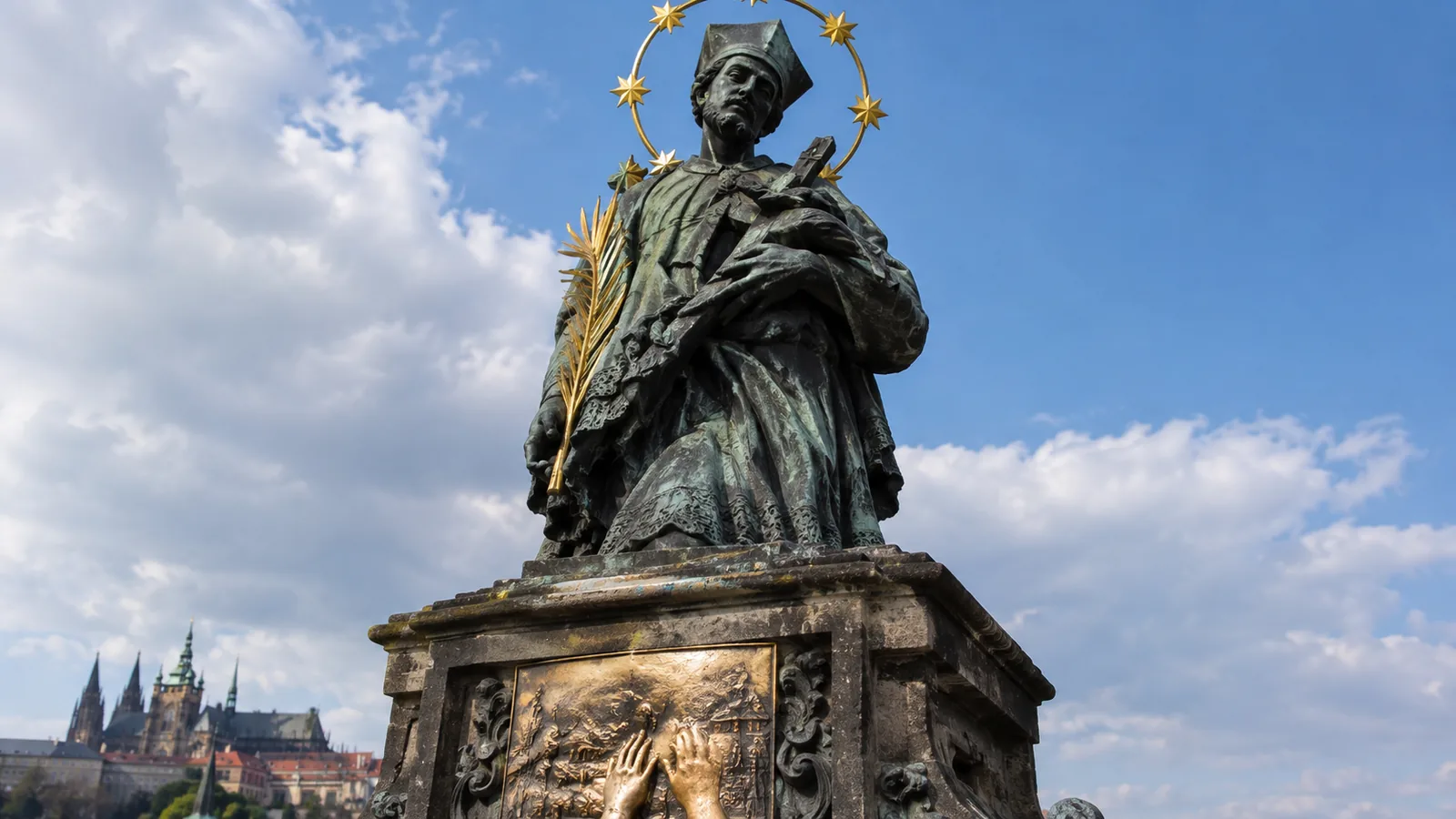
Are the Charles Bridge statues originals or copies?
Both. Many have been replaced by copies since the early 20th century, but about a third are still Baroque originals, and the 19th and 20th century works are originals too.
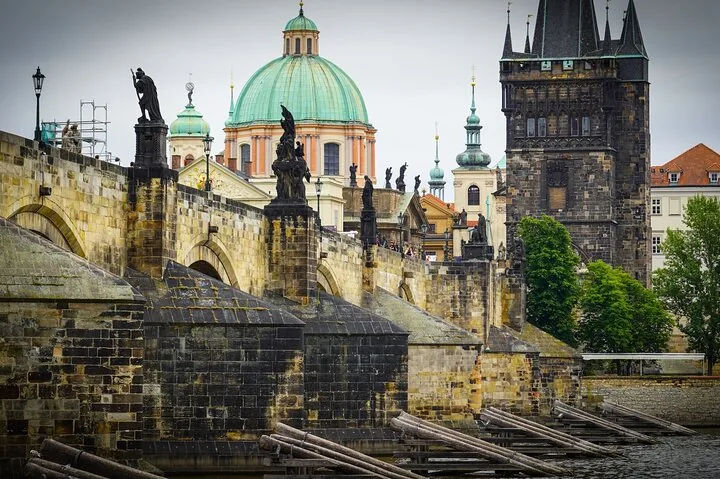
You will read everywhere that all the statues are copies. That is not right. The sandstone used for most of them weathers badly, and since the early 1900s the worst have been taken indoors and replaced by copies: St Luitgarde, St Ivo, St Francis Xavier, St Ludmila, St Adalbert, St Augustine and others. But Czech Wikipedia counts about a third of the statues on the bridge as Baroque originals still in place, among them the bronze St John of Nepomuk, St Anthony of Padua, St Jude Thaddeus, St Cajetan, St Vitus, the Cosmas and Damian group and the famous group with the Turk.
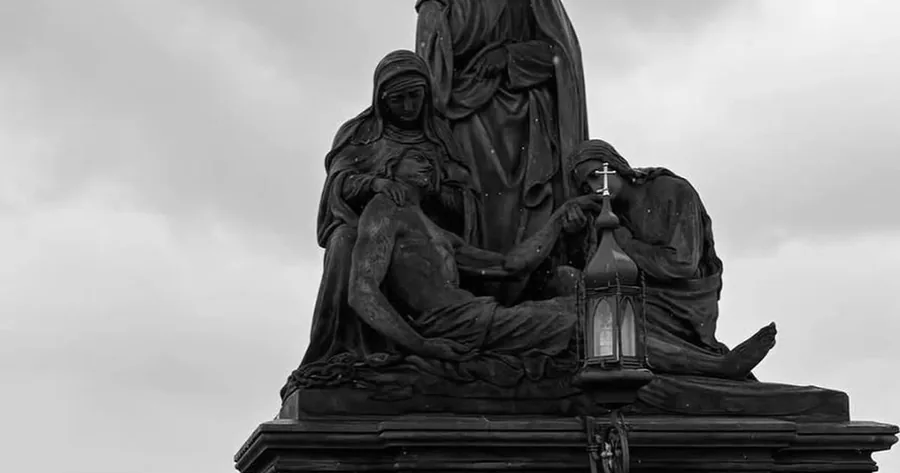
Several others are 19th-century originals. In the 1850s the brothers Josef and Emanuel Max replaced decaying Baroque works with new statues, St Joseph, St John the Baptist and the Pietà among them, and Emanuel's St Christopher took the place of an old guardhouse. Saints Cyril and Methodius, by Karel Dvořák (1928 to 1938), replaced a Jesuit group lost in the flood of 1890, and is the only modern work on the bridge.
Where are the originals? Most are in the National Museum's Lapidarium at the Výstaviště exhibition grounds, which is closed until further notice, and in the Gorlice hall in the casemates under Vyšehrad, which you can see on the guided casemate tours that run daily from the Cihelná gate. Gorlice keeps six of them, including St Ludmila, St Adalbert and St Anne.
| Statue | Original | Copy on the bridge | Original kept at |
|---|---|---|---|
| St Luitgarde (Braun) | 1710 | 1995 | National Museum Lapidarium |
| St Ivo (Braun) | 1711 | 1908 | Lapidarium |
| St Francis Xavier (F. M. Brokoff) | 1711 | 1913 | Lapidarium |
| Madonna, St Dominic and St Thomas Aquinas | 1708 | 1958 to 1961 | Lapidarium |
| St Ludmila (Braun) | After 1720 | 1999 | Gorlice, Vyšehrad |
| St Anne (Jäckel) | 1707 | 1999 | Gorlice |
| St Adalbert (Brokoff brothers) | 1709 | 1973 | Gorlice |
| St Augustine, St Nicholas of Tolentino (Kohl) | 1708 | 1970 and 1971 | Gorlice |
| Madonna and St Bernard (Jäckel) | 1709 | 1978 to 1980 | Gorlice |
| St Francis Borgia (F. M. Brokoff) | 1710 | 2017 | Removed for safekeeping |
| St Vincent Ferrer and St Procopius (F. M. Brokoff) | 1712 | 2024 | City Gallery store |
| St John of Nepomuk (bronze) | 1683 | Original on the bridge | Reliefs on the base are copies |
What are all 30 statues, in order?
Fifteen piers, two statues each. Walking from the Old Town towards the castle, the south side is on your left and the north side on your right.
Use this table on the bridge. Numbers are the piers, counted from the Old Town Bridge Tower. Bruncvík, the knight on the side of a pier above Kampa, is not counted among the thirty.
| Pier | Left (south) side | Right (north) side |
|---|---|---|
| 1 | St Ivo (Braun, 1711) | Madonna and St Bernard (Jäckel, 1709) |
| 2 | St Barbara, Margaret and Elizabeth (Jan and F. M. Brokoff, 1707) | Madonna, St Dominic and St Thomas Aquinas (Jäckel, 1708) |
| 3 | Pietà (Emanuel Max, 1859) | Calvary, the bronze crucifix (Christ c. 1628, set up 1657) |
| 4 | St Joseph (Josef Max, 1854) | St Anne (Jäckel, 1707) |
| 5 | St Francis Xavier (F. M. Brokoff, 1711) | Saints Cyril and Methodius (Karel Dvořák, 1928 to 1938) |
| 6 | St Christopher (Emanuel Max, 1857) | St John the Baptist (Josef Max, 1855) |
| 7 | St Francis Borgia (F. M. Brokoff, 1710) | St Norbert, Wenceslas and Sigismund (Josef Max, 1853) |
| 8 | St Ludmila with the young Wenceslas (Braun, after 1720) | St John of Nepomuk (bronze, 1683) |
| 9 | St Francis of Assisi (Emanuel Max, 1855) | St Anthony of Padua (Mayer, 1707) |
| 10 | St Vincent Ferrer and St Procopius (F. M. Brokoff, 1712) | St Jude Thaddeus (Mayer, 1708) |
| 11 | St Nicholas of Tolentino (Kohl, 1708) | St Augustine (Kohl, 1708) |
| 12 | St Luitgarde (Braun, 1710) | St Cajetan (F. M. Brokoff, 1709) |
| 13 | St Adalbert (Brokoff brothers, 1709) | St Philip Benizi (Mandel, 1714, marble) |
| 14 | St John of Matha, Felix of Valois and Ivan, with the Turk (F. M. Brokoff, 1714) | St Vitus (F. M. Brokoff, 1714) |
| 15 | St Wenceslas (Böhm, 1858) | Saints Cosmas and Damian (Mayer, 1709) |
Which statues are the finest?
St Luitgarde by Braun, the Turk group by Ferdinand Brokoff, and St Francis Xavier. Look at these three if you look at nothing else.
St Luitgarde (pier 12, left) is the masterpiece. Matthias Bernard Braun was 26 and fresh from Italy when he made it in 1710. It shows the blind Flemish nun's vision: Christ leans down from the cross and draws her to the wound in his side. No props, no crowd of symbols, one intimate moment in stone. Czech art historians rank it the best work on the bridge.
The Turk group (pier 14, left) is the most fun. The Trinitarian order ransomed Christian captives, and Brokoff put a half-caricatured Turkish guard with a dog in front of a barred cave full of prisoners. Prague people call it “the Turk on the Prague bridge”. Look up for the stag with a cross between its antlers.
St Francis Xavier (pier 5, left) shows the Jesuit missionary with an Indian prince kneeling for baptism, the whole scene carried on the shoulders of figures from the peoples he preached to. The boy with the book is probably a self-portrait of the 23-year-old sculptor. The original fell into the river in the 1890 flood; the copy dates from 1913.
Two curiosities: St Philip Benizi (pier 13, right) is the only marble statue on the bridge, carved in 1714 by the Salzburg sculptor Michael Bernhard Mandel from Salzburg marble. And St Vincent Ferrer and St Procopius (pier 10, left) carries inscriptions boasting of 40 people raised from the dead and 100,000 sinners converted.
What is the Hebrew inscription on the crucifix?
A verse from Isaiah, “Holy, holy, holy is the Lord of hosts”, paid for in 1696 by a Jewish man fined for alleged blasphemy. Plaques added in 2000 explain the injustice.
A cross has stood on pier 3 (right side) since the bridge was built. The bronze body of Christ, cast around 1628 and bought in Dresden in 1657, is the oldest sculpture on the bridge. The gilded Hebrew letters around it date from 1696. Cartouches in Czech, Latin and German state that a Jew paid for them as a fine for mocking the cross.
The plaques now on the railing say that the accused, Elias Backoffen, was convicted unjustly, and that the Hebrew was chosen to humiliate the Jewish community. In 2000 the city added plaques in Czech, English and Hebrew on the railing beside the cross, as a gesture of reconciliation. The figures of Mary and St John either side are by Emanuel Max (1861).
Who are Bruncvík and Bradáč?
Two older figures outside the thirty: a knight on a pier above Kampa, and a bearded stone head in the embankment wall at the Old Town end.
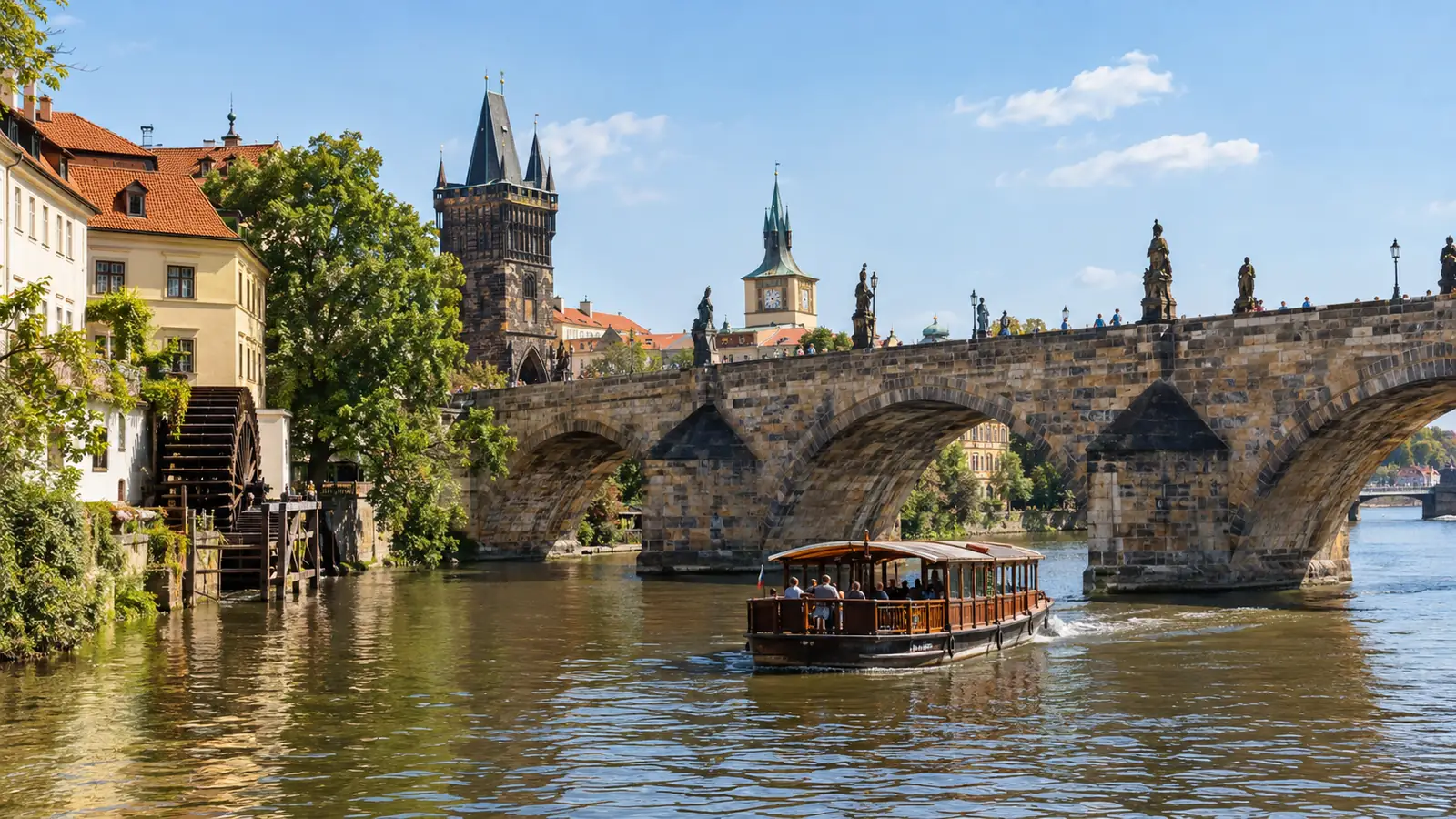
Bruncvík stands on the side of the pier above Kampa island, below the parapet, so you see him best from the steps down to Kampa or from a boat. He is a legendary knight with a gilded sword and a lion at his feet. The first statue, from around 1500, marked the edge of the Old Town's jurisdiction; it was shot down by the Swedes in 1648, and the present one is by Ludvík Šimek, 1884. Legend says a magic sword is walled into the bridge, and that St Wenceslas will draw it when the country is in its greatest danger.
Bradáč, “the bearded one”, is a stone head in the embankment wall below Křižovnické náměstí. It was originally part of Judith Bridge, the 12th-century bridge that stood here before Charles Bridge, and it is probably the oldest sculpture connected with the crossing. You see it from the water, which is one more reason to take the canal cruise, whose boats leave from the old Judith harbour close by.
Is a guided tour worth it for the statues?
Yes, if you want the stories: a guide turns thirty saints into thirty stories. On your own, this page and twenty minutes will do.
The statues carry no labels beyond Latin and Czech inscriptions, so most people walk past twenty-eight of them. A guide fixes that. The guided walk and river cruise by PragueWay crosses the bridge with a local guide, then puts you on a boat under the arches; Sebtona wrote on Viator in October 2026: “Josef was a fantastic, friendly tour guide with a detailed knowledge of the area and its history.” Note that on the boat the commentary is a recording, not your guide.
For a cheaper first-day overview, the Old Town and Charles Bridge walking tour ($21) ends across the bridge. The Charles Bridge Museum also has a section on the statues, and it is included with the canal cruise.
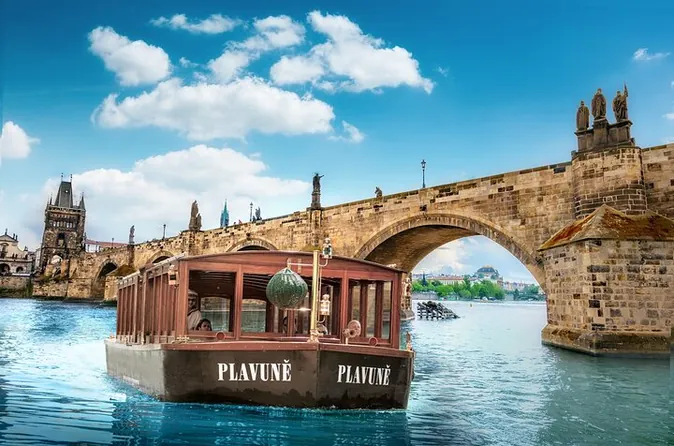
A local guide over the bridge and through the Lesser Town, then the boat under the arches, with the museum included.
Check dates Tour detailsFrequently asked questions
How many statues are on Charles Bridge?
Thirty statues and statue groups, two on each of fifteen piers, mostly set up between 1706 and 1714. The knight Bruncvík, on the side of a pier above Kampa, is extra.
Are the statues on Charles Bridge real?
Some are originals and many are copies. Copies replaced the most weathered sandstone works from the early 20th century on, but about a third of the statues are still Baroque originals, including the bronze St John of Nepomuk.
Where are the original Charles Bridge statues?
Mostly in the National Museum's Lapidarium in Prague 7, closed until further notice in October 2026, and in the Gorlice hall under Vyšehrad, which you can visit on the casemate tours.
Which is the oldest statue on Charles Bridge?
St John of Nepomuk, cast in bronze in 1683, is the oldest statue in the Baroque series. The bronze Christ on the crucifix is older, from around 1628, but it is part of the cross rather than a free statue.
Ready to book
Book your visit
Free cancellation up to 24 hours before on every option. Prices are from-prices in USD and move with the season.
Charles Bridge Guided Walk & River Boat Cruise
- Guided walk with an English-speaking local guide
- River cruise with an audio guide on board
- A drink and a small snack on the boat
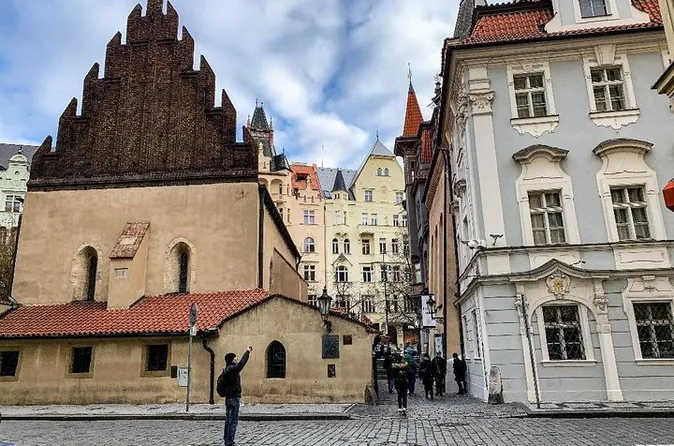
Old Town, Jewish Quarter & Charles Bridge Walking Tour
A first-day overview that ends across the bridge
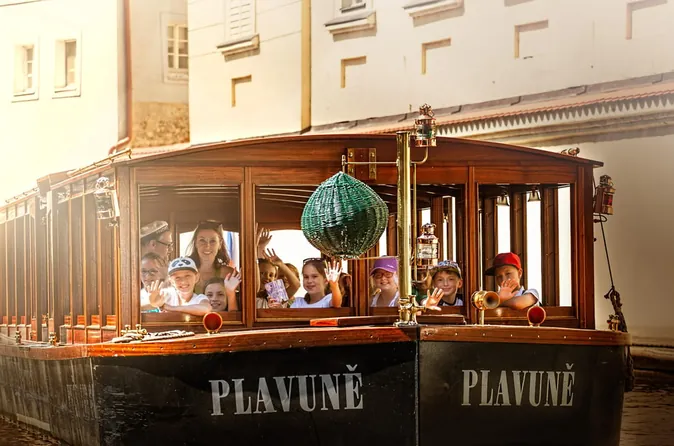
Canal Cruise under Charles Bridge & the Devil's Channel
- 45-minute boat ride under Charles Bridge
- Audio commentary in 19 languages on your own headphones
- A drink (beer, lemonade, tea, coffee or mulled wine)